
Eye-pixels! They’re pixels for your eyes! Allow me to explain
In a recent article in the journal Nature, researchers developed a new technology with the smallest pixels ever, in a screen that has the highest possible resolution that our eyes can perceive!
The 4k vs 8k debate fans will know that in any screen, resolution is determined by pixel size and pixel number. Higher resolution makes images look more realistic to us. But in instances like modern VR technology, a small screen close to the eye limits such an experience.
Ultra high resolution is difficult to achieve because as pixel size gets smaller, their emission quality is degraded. E-paper uses ambient light for visibility and can maintain high contrast regardless of pixel size, but cannot achieve high-resolution. Through this new “metapixel” technology, the research team bypasses both of these restrictions to meet maximum resolution!
Is this really the max resolution?
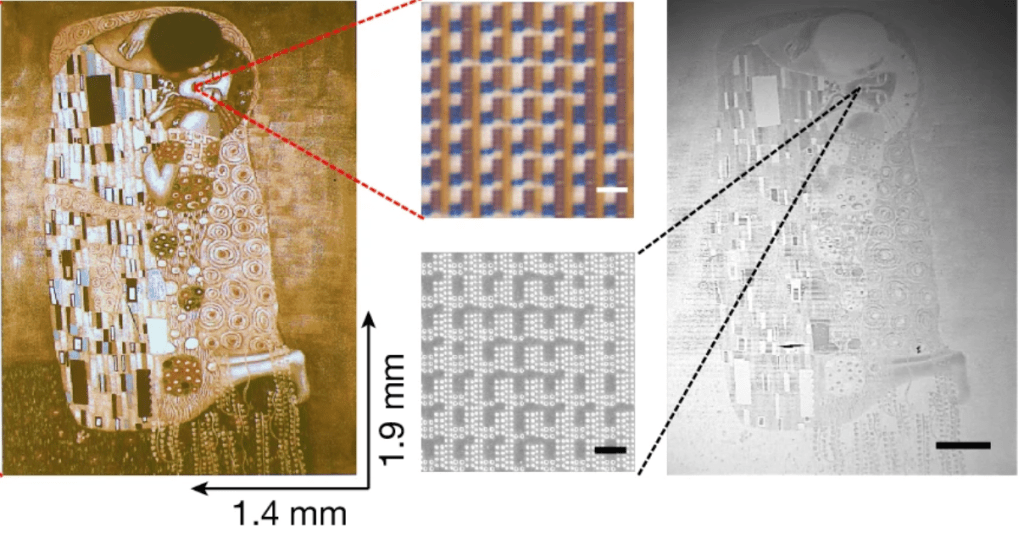
This research team worked on what they call “retina e-paper” that can be placed very close to the eye. Each pixel is approximately 560nm large and the whole screen is about the size of your pupil. This means the mini-screen has a resolution of over 250 thousand pixels per inch! This is equivalent to the visual resolution limit.
In this arrangement, each pixel roughly corresponds to a single eye cell. The eye cells that receive light information are called photoreceptors and specialize into rods & cones.
The team demoed this new tech in fun scientist fashion by showing a tiny version of Klimt’s artwork “The Kiss” on a surface area of 1.4 x 1.9 millimeters – about 1/4000th of a smartphone. I’ve got to say, it looks pretty good!
How does this technology work?
E-ink is a passive screen, it has no light source but the colors appear from ambient light when it hits the specifically engineered surface. This works the similarly to how iridescent feathers show color in hummingbirds, through their microstructure. Here, each tiny pixel contains particles of tungsten oxide which are able to manipulate color depending on their size and position. In doing so, they were able to create pixels that reflect red, green, and blue – which can be used to generate all colors. With a small voltage, the particles can be turned “off” to black.
What are the benefits and downsides?
The obvious benefits are the screen’s super small size, and because of that its low energy consumption. However, the researchers state that more development is needed on improving the color gamut, refresh rate, lifetime, and lowering voltage. They propose that with more development this could be the next solution for immersive VR systems, although the refresh rate is a large issue to overcome.
Personally, my thoughts went to this being another way of getting ads in our eyes, but I hope I’m wrong. On a more positive note, I wonder how this could be used to improve vision deficiencies. It seems like a piece of technology with… eye-opening potential! What do you think it could be used for?
Article: https://doi.org/10.1038/s41586-025-09642-3
Source: https://www.gu.se/en/news/minimal-pixels-match-the-resolution-of-the-eye
As covered on a special weekend edition of the Daily Tech News Show on November 6th, 2025. For a more detailed discussion of the topic, listen here:
 Nicole Ackermans, CVN lab
Leave a comment