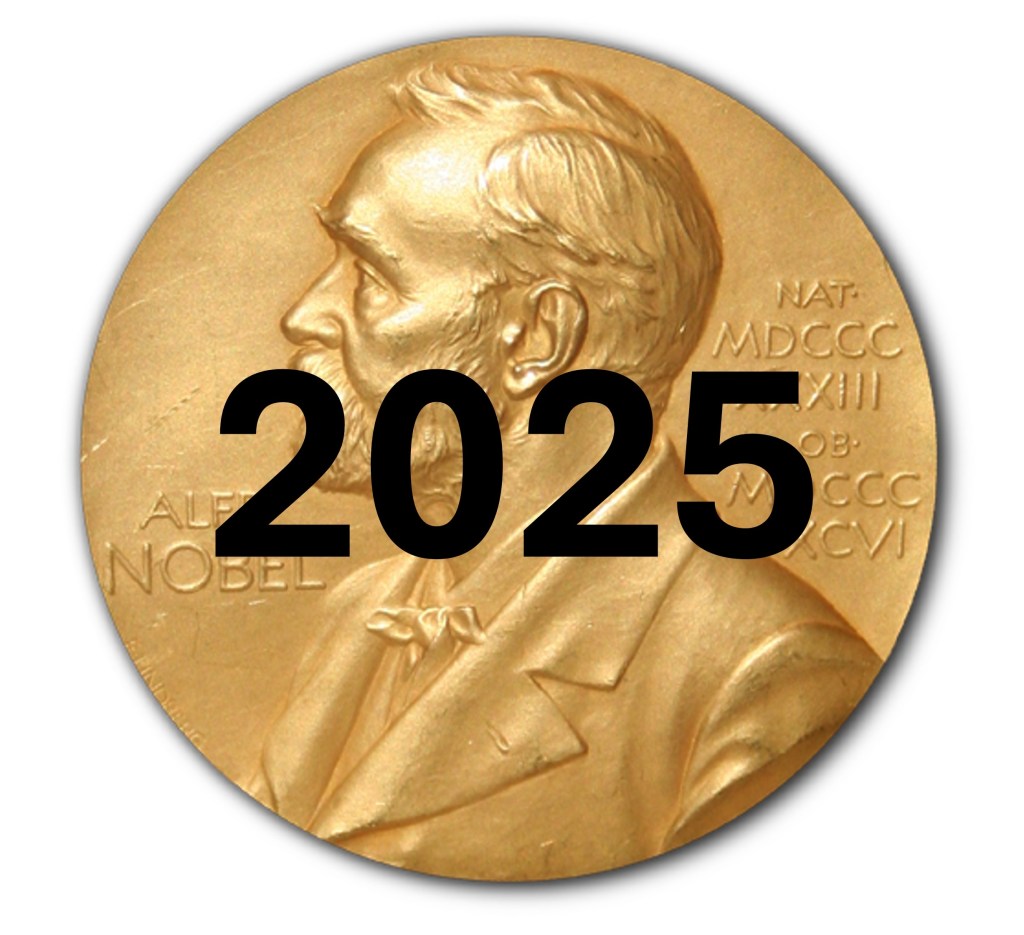
This October the Nobel prizes were announced. These awards “confer the greatest benefit to human kind”. I broke down the three science prizes in a bit more detail.
Physics
Awarded to John Clarke, Michael H. Devoret, and John H. Martinis for their discovery in quantum mechanics that paved the way for cellphones and cameras.
Nobels are based on a whole career of work, so this award was given based on experiments performed in the 1980s. These experiments proved the principles of quantum mechanics called “quantum mechanical tunneling” – which describes particles passing through a barrier when they shouldn’t. The research was done using a superconductor electrical system.
Chemistry
Awarded to Susumu Kitagawa, Richard Robson, and Omar M. Yaghi for their discovery of molecular structures that can harvest water from desert air, or extract pollutants from water.
These experiments also occurred in the 80s and developed over the following 15 years. Building on each other’s work, these researchers developed a chemical structure that forms a metal organic framework. These structures can act as a sort of extremely efficient filter or net for other chemicals.
Physiology or Medicine
Awarded to Mary E. Brunkow, Fred Ramsdell, and Simon Sakagushi, for their discoveries concerining immune system regulation. Their research explores how to prevent our own immune systems from harming the body, and has led to treatments for cancer and autoimmune disease.
The body’s immune system has “helper” T-cells that patrol the body and sound they alert if they find a problem. It also has “killer” T-cells which have either been infected or can attack other cells. In the case of an autoimmune disease, these cells can attack the body by mistake.
Together, the winners identified a new group of “regulatory” T-cells that help prevent the other types of T-cells from attacking themselves and contribute to helping the immune system calm down after an invasion. When they mapped the new T-cell genome, it revealed the cause of a rare autoimmune disease called IPEX where these new T-cells cells were mutated.
Currently, there are over 200 clinical trials in process that build off their research. Fun fact, one of the winners was hiking off-grid when he got the call from Sweden, so it took him a few days before he found out about the award!
What are some issues with the Nobel prizes?
Nobel prize science categories are limited to only physiology/medicine, physics, & Chemistry, excluding recognition for other types of science. These categories remain unchanged since 1901, and are likely to remain. Every year when we cover the Nobel prize, I bring up the issues with the prizes. On one hand they are a great way to communicate science to the public and often highlight basic science, which can get a bad rap when misunderstood.
On the other hand, the prizes suffer from a lack of diversity. To date, amongst the STEM Nobels, only 4% are women, and there have been zero Black winners. Only 1% of Nobel winners for any category are black.
The prizes also have “neoptisim” issues, with the majority of winners concentrated in 5 countries, and mostly at US universities. This year alone the University of California set a record with 5 Nobel prize winners in the same year. 96% of STEM prizes are concentrated in the same academic families. A prize winner is more likely to train a future prize winner. And for good reason, being part of the Nobel Club affects university rankings, perpetuating the cycle.
Allegedly, an author’s scientific work needs to be referenced at least 1000 times to be eligible. But referencing reflects societal bias and minorities are at a disadvantage, considering awards are based on science performed 20 or more years ago, when minorities were much less prominent in science.
Nature did a really great breakdown on “how to win a Nobel prize” that I recommend checking out (spoiler: be a 57 year old white man in the US, trained by a Nobel laureate).
I also covered the Nobel’s fun cousin, the 2025 IgNobel prizes, on a previous segment!
Source: https://www.nobelprize.org/all-nobel-prizes-2025/
As covered on a special weekend edition of the Daily Tech News Show on October 18th, 2025. For a more detailed discussion of the topic, listen here:
 Nicole Ackermans, CVN lab
Leave a comment