
An allegedly crash-proof drone that attributes its inspiration to woodpeckers has been in the news. I specialize in woodpecker skulls and have a lot of skepticism around woodpecker biomimicry. Let’s get into it.
The article “Collision-Resilient Winged Drones Enabled by Tensegrity Structures” was published in Aug 2025 in the Journal Advanced Robotics Research. This drone was engineered by a robotics team at EPFL in Switzerland. The press calls it a “Crash-proof drone inspired by the head of the woodpecker”.
For me, this article came out at a perfect time, as I just published a review on the history of human thought on brain injury in head-hitting species. It goes over how biomimicry, especially for engineering purposes, often gets the biology wrong. That topic may seem niche but has real world applications just like this drone.
This drone is a fixed-wing drone that uses self-stabilizing structures called tensegreties, held in place by taught cables. This drone is said to absorb shock energy that would otherwise break the wings off the drone or damage the interior electrical components. Allegedly reducing impact forces by 70%.
What’s the link to woodpeckers?
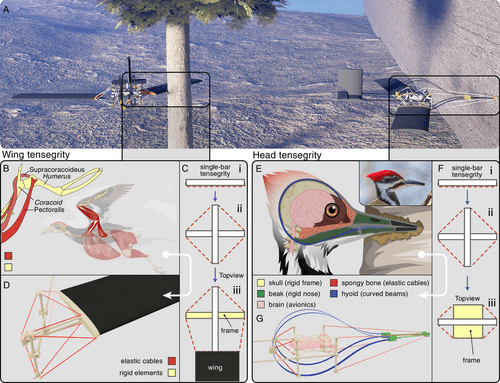
This is where it all falls apart for me. The idea is that the woodpecker’s hyoid apparatus (not a single bone) inspired the tensegreties used in the drone… except that’s not how their biology works at all!
The press tagline used was this:
“Despite the fact that they bang their heads against trees on a daily basis, woodpeckers don’t suffer brain injuries. Inspired by the tough-headed birds, scientists have developed a fixed-wing drone that can survive frontal collisions.“
What’s the issue?
It has yet to be scientifically proven whether or not woodpeckers get brain injuries from pecking. In addition, the woodpecker’s hyoid structure is not proven to absorb shock. Some publications might make this claim, but with insufficient evidence (this is explored in detail in my review).
What first set my alarm bells ringing is the likely AI-generated woodpecker figure, that shows a human brain! Woodpeckers have smooth brains, and the rest of the structures in that figure don’t represent anything that actually exists.
What do we do about this?
I can’t personally speak to the integrity of the engineering, as that is outside of my wheelhouse. Terrible figure aside, I can’t entirely blame the engineers, they cited sources they assumed were credible without digging deeper. Overall, biological misunderstanding is an issue when it comes to bioinspired design and seeking collaborations with biologists would help avoid such glaring errors, and likely even help improve the design!
Article: https://doi.org/10.1002/adrr.202500050
As covered on a special weekend edition of the Daily Tech News Show on October 4th, 2025. For a more detailed discussion of the topic, listen here:
 Nicole Ackermans, CVN lab
Leave a comment