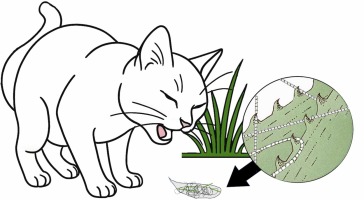
If your cat (or dog) has coughed up a hairball recently, it may have been for science!
This recent publication from the Journal of Veterinary Behavior explores why cats and dogs eat grass just to throw it up later. I find the methodology both hilarious and genius. The researchers opportunistically collected “six regurgitated masses” from the author’s two cats. The “masses” (hairballs) were then dried, slide mounted, and coated in a fine dusting of gold to prepare for imaging on a scanning-electron microscope (SEM).
This is exactly how curious minds work (including myself in this). I assume the author saw the hairball and went “huh, I wonder if I could find out more about this with our fancy microscope!”.
How does a SEM work?
SEMs work by scanning a 15 KV electron beam across a small sample’s surface. The gold coating is needed because the interactions between the sample and the gold electrons generate specific signals. These signals bounce off the sample and are collected by electron detectors, which then translate the signals into a high resolution 3D image. This image then allows you to see the sample’s topography in very fine detail.
Back to cat barf…
The scan showed that the “masses” were mainly composed of plant microstructures with serrations, spikes and hooks that snag and entangle hairs. Meaning, the goal of grass-eating may be to clean out the cat’s digestive system like a drain snake! Isn’t that neat?!
In perhaps the most expensive (and awesome) analysis performed on cat barf, The authors also identified that the masses were composed of multiple plant species through DNA analysis. Given how sensitive whisker mechanoreceptors are, the authors pose that cats might rub the plants with their whiskers before eating them to determine which ones have the best hair-clearing properties.
Article: https://dx.doi.org/10.2139/ssrn.5243632
As covered on a segment of the Daily Tech News Show on October 1st, 2025. For a more detailed discussion of the topic, listen here:
 Nicole Ackermans, CVN lab
Leave a comment