As covered on the Daily Tech News Show on April 9th 2025. For a more detailed conversation, listen here:
First source: https://time.com/7274542/colossal-dire-wolf/
These days it’s like Colossal knows I’m about to go on DTNS and makes up a story just for me to debunk!
On March 7th, Colossal Biosciences spread the word of their latest PR stunt, two adorable little puppies that they have been calling “dire wolves”. They named them Romulus and Remus, after the founders of Rome, and their sister Khaleesi. But as is always the case with Colossal, these pups are not quite what they claim to be…
Tom- Are we talking dire wolf from Game of Thrones? What exactly is a dire wolf?
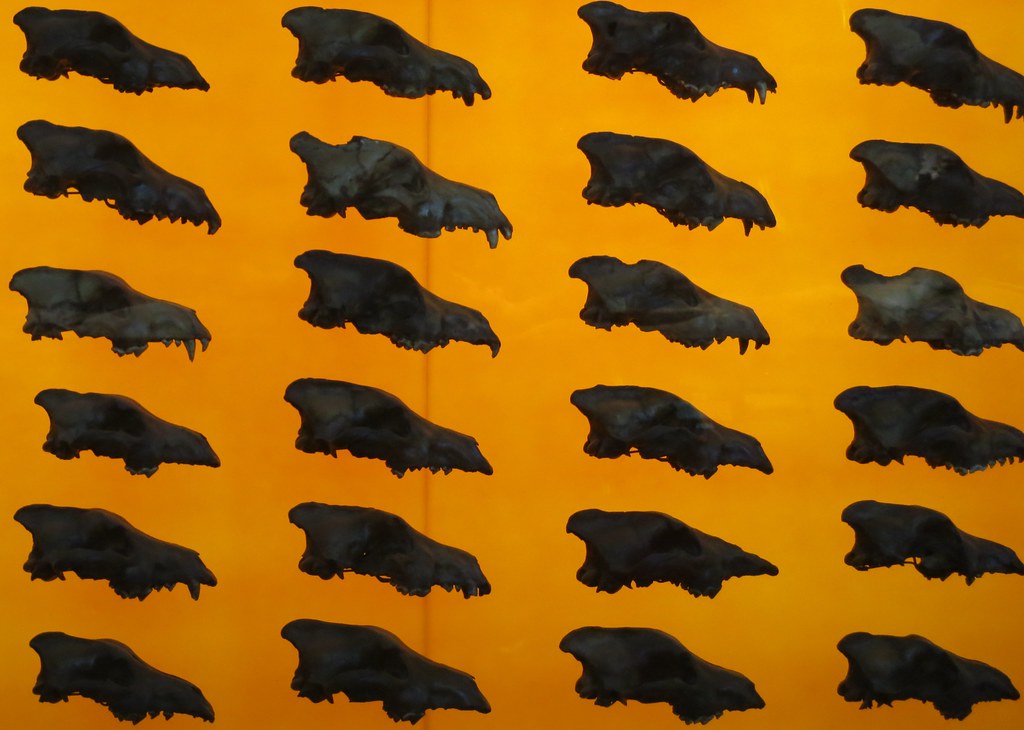
Tom you live in LA right? Have you been to the La Brea Tar pits?
They have an entire wall of dire wolf skulls. They are from the pleistocene, the epoch which ended 11 thousand years ago, also known as the ice age.
What we call dire wolves are large canids from the pleistocene that appear to have a similar bone structure as our grey wolf, but they are in fact genetically distinct from wolves, as was uncovered by a 2021 study. The strong resemblance between the two is a case of convergent evolution, meaning the animals underwent similar environmental pressures leading to similar adaptations and appearances. Similar to how the Tasmanian tiger looks a lot like a coyote even though it’s a marsupial.
While grey wolves are from the Canis genus, like dogs, Dire wolves are from a completely different genus, Aenocyon. As Riley Black mentions on Bluesky, they last shared a common ancestor 5 million years ago.
Tom – So did Colossal De-extinct the dire wolf as they claim? I have a hunch this is not the case…
If you have followed the past few colossal stories I have covered here on DTNS, including the wooly mice last month, you may guess that your hunch is correct.
Scientists at colossal deciphered some parts of the dire wolf genome, inserted them into some genes of the grey wolf, and used domestic dogs as surrogates to carry the gene-edited pups.
They report that the pups are white, stockier than a grey wolf, and howl differently.
Tom – Is that enough to make a dire wolf?
A few edited genes does not a dire wolf make. A wolf has about 19,000 genes. Colossal’s scientists made 20 edits in 14 genes of the gray wolf. This is more like a grey wolf clone with 20 gene edits, some have called it a vaporwave wolf. To me it feels like putting genetic makeup on a pig. It basically disregards the reality of what this species was but pulls some aesthetic traits out and sticks them in another species. That’s not even counting for the environmental effect on the original genes. Small variations in hormone levels, temperature, or parental investment can change how offspring grow. None of that of course is able to be captured with minimal gene edits aiming for a cool-looking phenotype.
Tom – So what is the point?
This is the part I’m having a hard time wrapping my head around. This is an incredible amount of work. The researchers first needed to acquire ancient dire wolf specimens from a museum, extract ancient DNA, which is incredibly finicky. Then they need to patch together missing sequences in the genome, since it degrades with age. And the edit the grey wolf genome to accept those changes. They then inject the gene-edited nucleus into a grey wolf ovum (egg cell). They produced 45 of these edited ova, developing them into embryos in the lab. These embryos then get inserted into the uteri of surrogate dogs. They note that no dogs sustained a misscarriage or stillbirth which is surprising to me, as this is often the case with cloning work. The pups were born by c-section.
All of this is an incredible amount of work, but I have a hard time understanding why you would use it for what amounts to a PR stunt instead of conservation for the many endangered species out there who are becoming even more endangered by federal cuts in the US. The black footed ferret for example only has 300 remaining individuals in the wild. Or even help conservation of endangered wolves like red wolves, but that’s not as flashy of a news story.
Before we wrap up Tom, do you notice anything missing from this supposed breakthrough in science?
Tom – Did they publish their work?
Ethics aside, in the midst of all that is going on. Another big issue here is that none of this work has been peer reviewed. We don’t have access to the raw data. Scientists working with their peers to share data, confirm findings and replicate results is what makes up the basics of science. Without that we don’t have much more than vaporware wolves.
Update: The preprint is now out but not peer-reviewed (peep that author list…) : https://www.biorxiv.org/content/10.1101/2025.04.09.647074v1
Other Colossal coverage :

 Nicole Ackermans, CVN lab
Leave a comment